How a Flake Ice Machine Works: The Drum, the Blade and Subcooled Ice
Flake ice looks almost too simple to need explaining: thin, dry, white shards about the thickness of a coin, piled over fresh fish at a market or tumbling out of a machine into a storage bin. Yet the machine behind it makes ice continuously, without ever stopping to harvest, and the flakes come off the drum already colder than freezing point.
The four parts that do the work
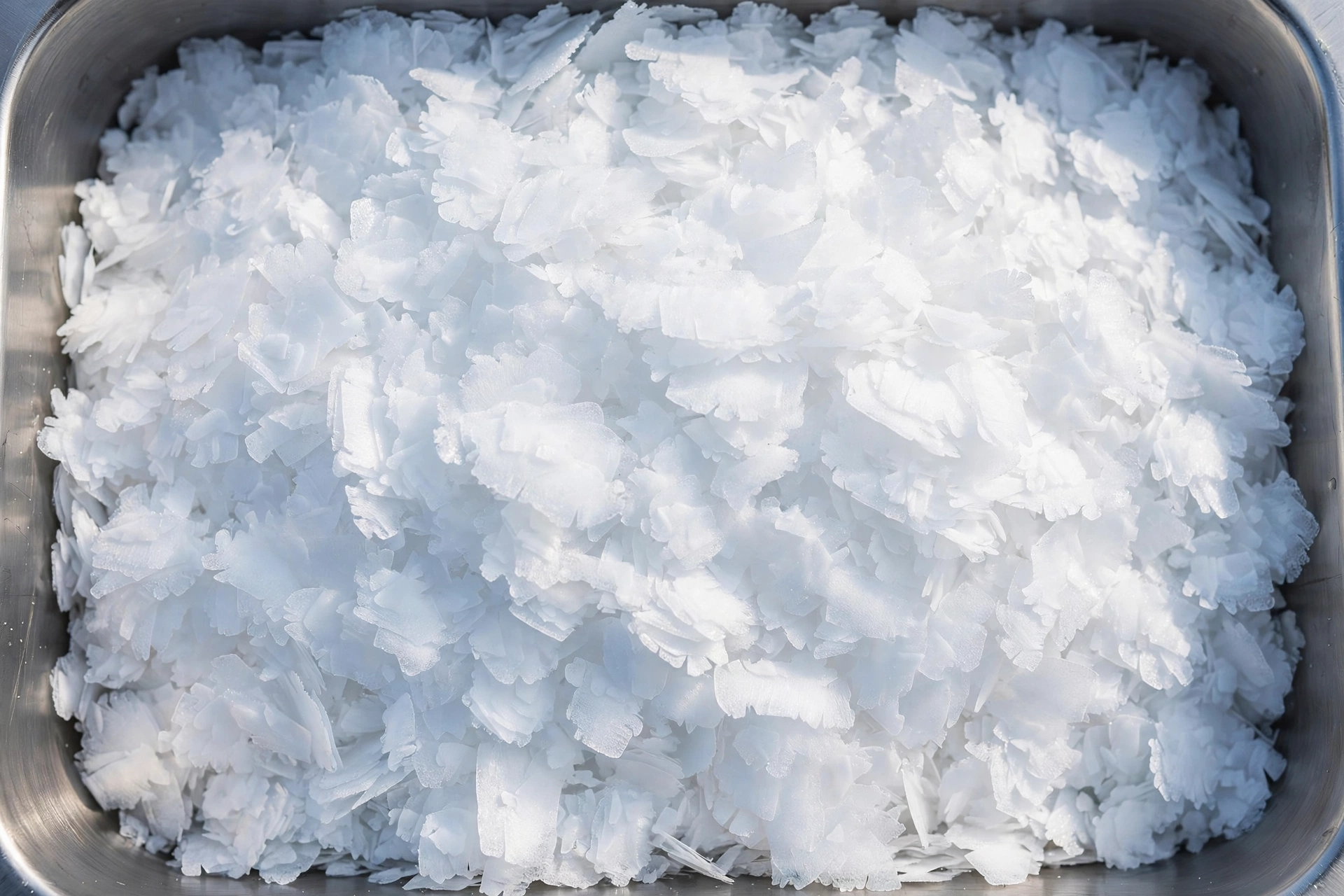
A flake ice machine is built around four systems:
- The evaporator drum. A vertical stainless-steel cylinder, the heart of the machine. Refrigerant evaporates on one side of the drum wall while water freezes on the other. The drum surface is held well below freezing, typically around −20 to −25 °C evaporation temperature.
- The refrigeration system. A compressor, condenser, expansion device and receiver circulate refrigerant, carrying heat away from the drum and rejecting it outside the plant room.
- The water system. A pump lifts treated water to a distributor at the top of the drum, which spreads it in an even film over the freezing surface. Water that does not freeze is caught in a tray and sump below and pumped back up again; a float valve tops the sump up as needed.
- The drive and blade. A motor and reducer turn a shaft inside the drum, carrying a precision blade — often called a reamer — that rides against the freezing surface. Heavy-duty bearings are specified for continuous 24-hour duty, because this assembly never rests while the machine is running.
Food-grade 304 stainless steel is the standard for every part that touches water or ice. Some drums use hard-chrome plated carbon steel instead, which resists blade wear; ask what the drum is made of.
Step by step: how the drum makes ice
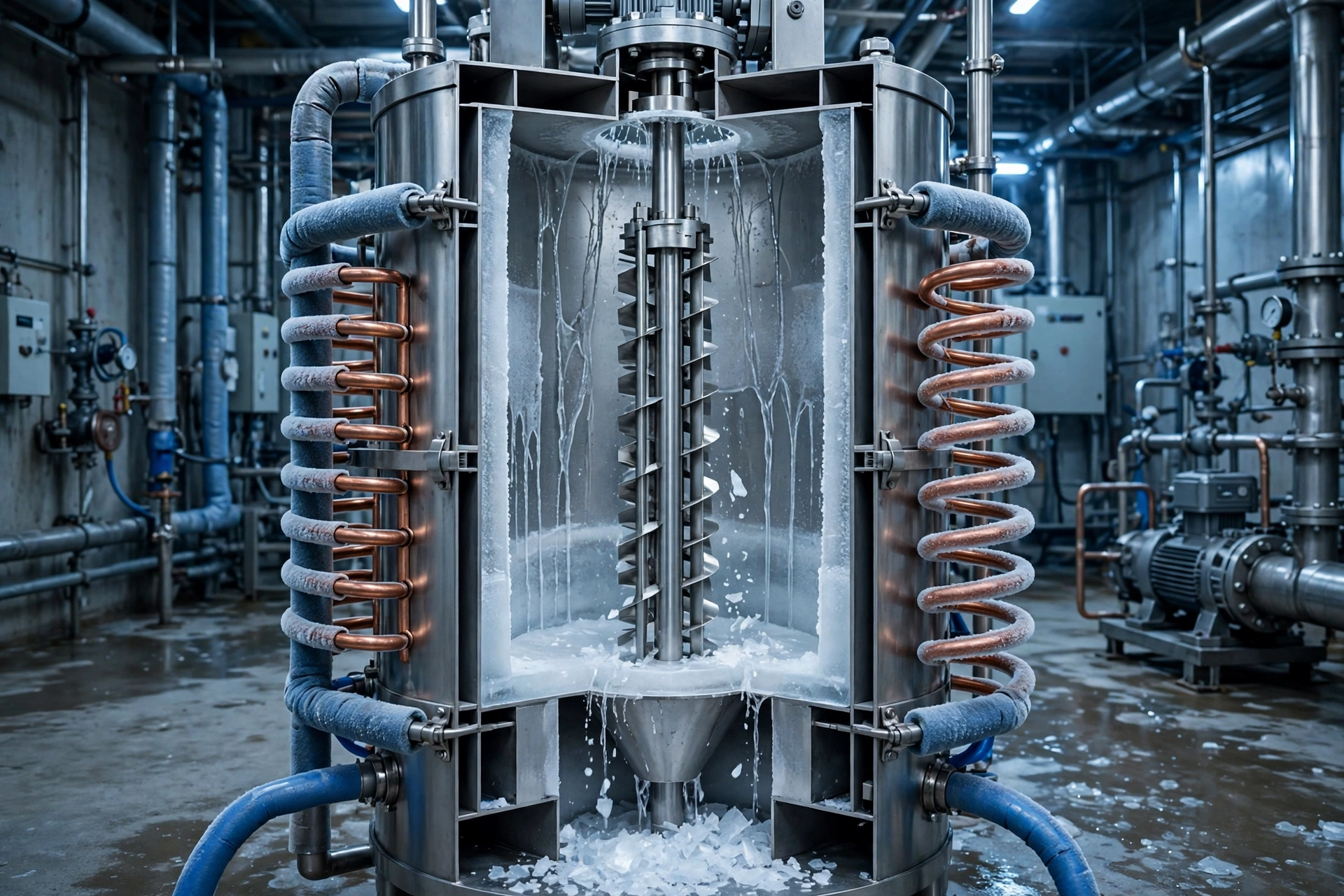
The process is a loop with no separate harvest stage. A tube ice machine, by contrast, freezes a batch, melts it loose with hot gas, and starts again — see the comparison in our tube, flake, block and cube ice guide.
- Water distribution. The pump delivers water to a rotating distribution tray above the drum, which cascades it uniformly over the freezing surface in a thin, even film. Even coverage matters: a dry patch makes no ice, and a flooded patch makes thick, wet ice.
- Freezing. Liquid refrigerant expands and evaporates on the other side of the drum wall, pulling heat through the steel. The thin water film freezes within seconds, building a layer only 1 to 2 mm thick.
- Scraping. The blade turns slowly around the drum and shears the thin sheet off the surface, breaking it into small, flat flakes. The blade is set to ride just clear of the drum — close enough to strip the ice clean, far enough not to score the metal.
- Collection. The flakes fall directly into an insulated storage bin or onto a conveyor below. Meanwhile the unfrozen water, already chilled close to freezing, is caught and recirculated, so very little water or cold is wasted.
| Flake ice machine | Tube ice machine | |
|---|---|---|
| Operation | Continuous | Batch cycles of 15–20 minutes |
| Harvest | Blade scrapes ice off the drum | Hot gas melts ice loose from tubes |
| Ice temperature | Subcooled, below 0 °C, dry | Near 0 °C, surface wet from defrost |
| Ice thickness | 1–2 mm flakes | 4–6 mm tube walls |
Why the ice comes off dry and subcooled
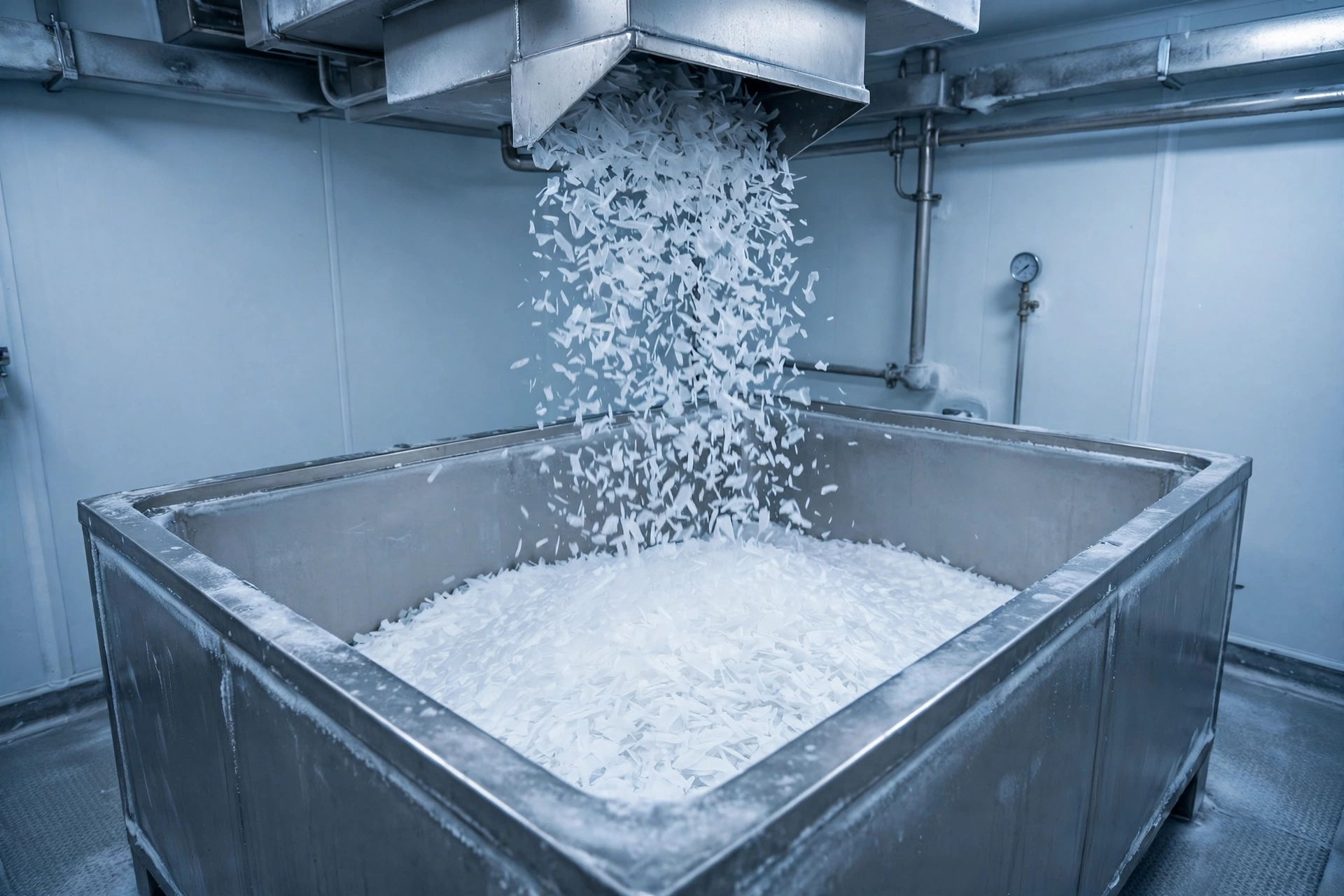
The cleverest detail of the design is one you cannot see: the water supply is interrupted just ahead of the blade. On many machines the rotating distribution tray is blanked off in the arc immediately before the blade passes, so no fresh water lands on the stretch of drum the blade is about to scrape. In that brief gap, the thin ice layer finishes freezing and cools below 0 °C — it becomes subcooled, dry and crisp, instead of wet and slushy. That is why a flake ice machine needs no hot-gas defrost in normal operation: a tube ice machine must spend energy warming its tubes to release each batch, while a flake machine simply lets the blade do the releasing, and the refrigeration circuit never reverses.
Dry, subcooled flakes flow freely instead of clumping into a solid mass, and they pour and spread easily by hand or shovel — handy when ice must be packed closely around fish and re-spread as the day goes on.
What the drum, the blade and your site decide
The output of a flake ice machine is decided less by its compressor than by the condition of its drum and blade:
- Blade sharpness and clearance. A sharp, correctly set blade strips the drum clean and makes uniform flakes. A dull or misaligned blade leaves ice behind, which insulates the drum, slows freezing, and makes flakes thicker and wetter. Ask how often the blade needs sharpening or replacing.
- Drum surface condition. Scale from hard water is the enemy here: even a thin mineral layer insulates the freezing surface and cuts output. Treat the feed water and descale on schedule. A scored drum also sheds flakes unevenly and wears blades faster.
- Rotation speed. The drum turns slowly by design. Running the blade faster does not make more ice; it makes thinner, more fragile flakes. Capacity comes from drum area and refrigeration, not from spinning the blade harder.
Rated capacity is measured under defined test conditions, so output on your own site also depends on the surroundings: warmer inlet water costs output, so measure it in the hottest season; a hot, poorly ventilated plant room raises condensing pressure and slows the refrigeration circuit; and flake ice needs an insulated bin or cold room sized for one to two days of production, because it is made continuously and melts faster than block ice. If you are sizing a machine, see our guide to calculating the capacity you actually need.
Where flake ice earns its keep

Flake ice is the fastest-cooling ice type there is: a ton of it has well over a thousand square metres of surface area in contact with whatever it covers. That is why it dominates uses where speed of cooling matters more than slow melting:
- Seafood and fishing. Flakes pack around fish without bruising the flesh, pull the temperature down fast, and keep the catch cold through display, transport and processing.
- Food processing and supermarkets. Poultry, meat and fresh produce are chilled or displayed on flake ice, which moulds itself around irregular shapes in a way cubes and tubes cannot.
- Concrete cooling. Batching plants mix flake ice into concrete to control the curing temperature — flakes melt and mix evenly through the batch, unlike block ice that must be crushed first.
Against that, flake ice melts faster than block ice, so it is not the best choice for keeping something cold for days without refrigeration.
The bottom line
A flake ice machine freezes a thin film of water on a cold rotating drum and scrapes it off with a blade — continuously, with no defrost cycle. The details decide the result: even water distribution, a sharp blade, a clean drum and good water treatment are what separate dry, uniform flakes from wet, uneven ones.
Nineyan builds flake ice machines from 1 to 20 tons per day. Tell us your daily demand, water conditions and what you are cooling for a recommended configuration: dina@nineyantech.com or WhatsApp +86 18819008672.