Planning need
An illustrative fishing supply business needs block ice for bulk cooling and local ice distribution. Daily demand, block weight and site conditions would be confirmed before equipment selection.
Reliable Ice-Making Solutions with Local Installation Support
Our manufacturing partner has supplied block ice machines to Vietnam and other Southeast Asian markets. A local technical service partner in Vietnam can provide on-site installation and commissioning support for your ice plant. Equipment requirements and service arrangements are discussed for each project.
Request a Quote for Your Ice Plant ↗Our local technical service partner in Vietnam can provide on-site installation and commissioning support. The service scope, scheduling and charges are discussed and agreed for each project.
Share your installation location, planned capacity and site conditions so the equipment and installation requirements can be reviewed together.
Example proposal — not a completed Nineyan project. This scenario illustrates how a block ice production inquiry for a fishing supply business could be developed. No customer, installation site, delivery date or operating results are claimed.
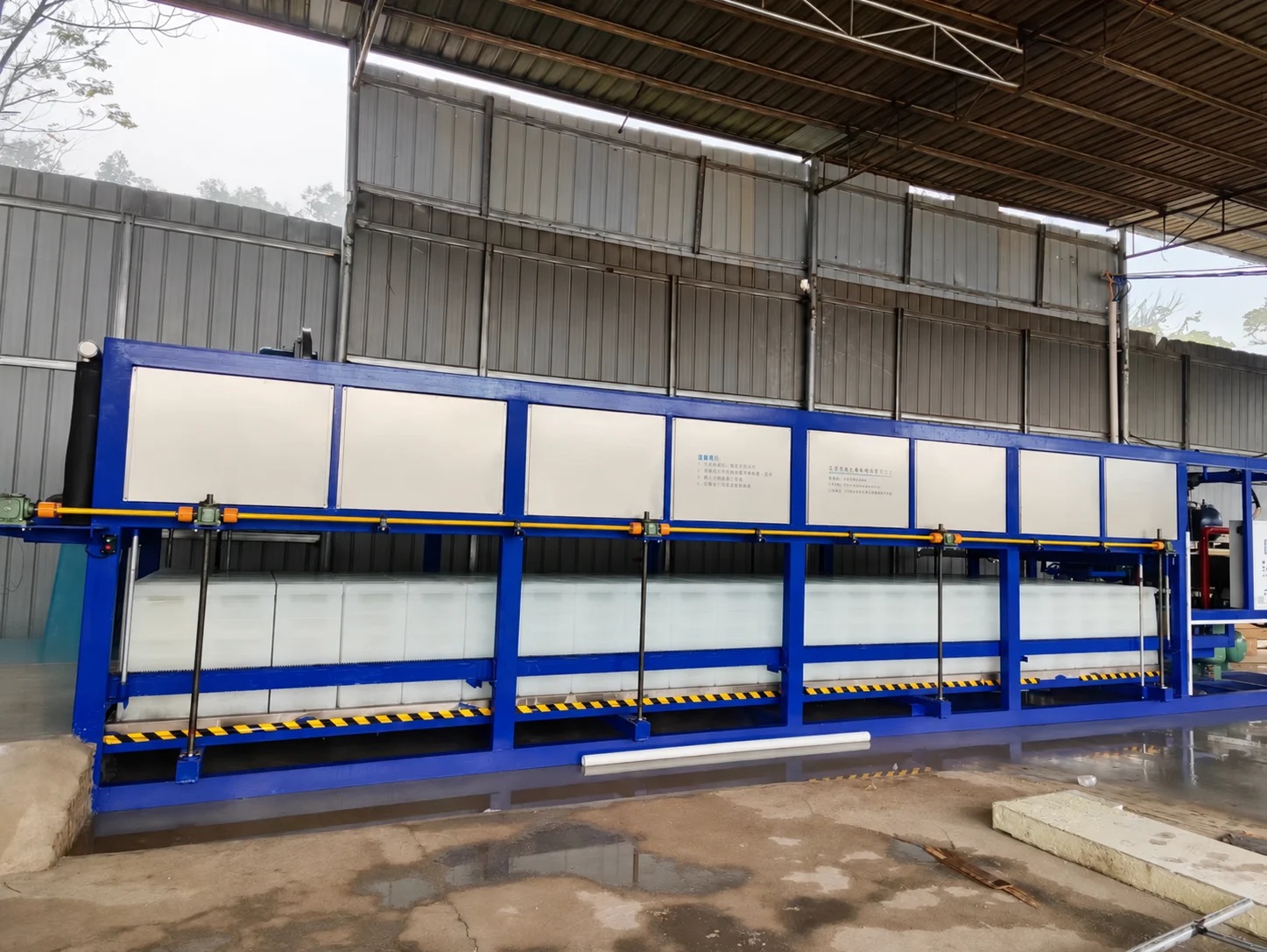
An illustrative fishing supply business needs block ice for bulk cooling and local ice distribution. Daily demand, block weight and site conditions would be confirmed before equipment selection.
Review direct cooling block ice equipment, water and power requirements, harvesting arrangements and ice handling. Capacity and refrigerant remain subject to the actual customer requirements.
Discuss on-site installation and commissioning with the Vietnam technical service partner. Scope, fees and schedule require a project-specific agreement.
This concept draws on publicly reported industry examples. Robin Machinery describes block ice equipment intended for Vietnam's fishing market. That is a third-party reported shipment, not Nineyan's project or evidence about the equipment pictured here.
Discuss Your Ice Plant Requirements ↗The owner identifies the pictured equipment as a 30-ton block ice machine. The calculations below use a nominal output of 30 metric tonnes per 24 hours, equal to 30,000 kg of ice. They are planning examples, not measured production results from a Vietnam installation. Block weight, freezing cycle, electrical demand, dimensions and performance test conditions for this pictured machine have not yet been confirmed.
Daily blocks = daily ice mass in kilograms ÷ weight of one block. A smaller block gives a larger block count, but does not increase the total daily ice mass. The weights below are illustrative alternatives; they do not establish that this machine supports each mold size.
| Illustrative block weight | Theoretical blocks / 24 hours | Calculation |
|---|---|---|
| 25 kg | 1,200 blocks | 30,000 ÷ 25 |
| 50 kg | 600 blocks | 30,000 ÷ 50 |
| 100 kg | 300 blocks | 30,000 ÷ 100 |
For example, if the confirmed mold produces 50 kg blocks and the plant achieves 30,000 kg in 24 hours, the arithmetic gives 600 blocks per day. This does not mean 25 finished blocks leave the machine every hour: harvesting occurs in batches. The average mass rate is 1,250 kg/hour over 24 hours, but a freezing-cycle schedule and mold count are needed to establish actual harvest times. Do not extrapolate a 24-hour rating to a shorter shift without checking the operating cycle.
Output and dispatchable stock must be checked against the manufacturer's operating conditions and the site's water supply, electrical supply, ambient conditions and harvesting arrangements. Storage and handling can also reduce the mass available for sale. As a calculation example only, allowing a hypothetical 10% reduction from 30,000 kg leaves 27,000 kg, equivalent to 540 blocks at 50 kg. The 10% figure is not a measured loss rate or a prediction for this machine.
A planned supply point near a quay can coordinate orders for vessels preparing to sail. Operators can book dispatch slots, separate advance orders from walk-in demand and maintain a stock plan. Whether this removes waiting time depends on harvest timing, inventory, loading access and the number of customers.
Fish landing, sorting and collection create successive cooling needs. Harbour ice supply can support these handoffs when paired with clean handling and suitable insulated containers. It does not repair fish quality already lost before icing.
Blocks can be kept whole for bulk handling and crushed when smaller particles are required. Select lifting, transfer and crushing arrangements before commissioning. A block ice machine alone does not establish a complete unloading or fish-handling system.
Weighing and dispatch records help allocate ice among vessel owners, landing agents, fish buyers and transport operators. Record kilograms supplied rather than block count alone, particularly when different block weights are used.
A harbour supply point can form part of a cooling plan extending from vessel to collection vehicle. Check route length, insulation, time before loading and meltwater drainage. Extra ice cannot compensate for every weakness in transport practices.
Departure windows and fish landings may cluster. Compare demand by time of day with batch harvests and stored ice rather than relying on the daily total. Reserve stock and alternative supply arrangements should be sized for actual seasonal demand.
Assume, solely for planning, that 30,000 kg is available and one vessel orders 2,000 kg. Dividing gives 15 such orders before any allocation to other customers, reserves or losses. At 50 kg per block, that is 40 blocks per order. This is a dispatch calculation, not a claim that one machine can serve 15 vessels of any size or trip duration. An operator would first confirm each vessel's intended trip, expected catch, insulation and existing ice stock.
FAO explains that ice needs good contact with fish: large blocks should be crushed into suitable small pieces before direct application. Clean ice should surround the fish, and gentle handling helps avoid physical damage. The block format offers a bulk storage option, while crushing provides contact during use. Prompt icing and protection from heat matter; ice does not reverse deterioration that has already occurred. Source: FAO, use of ice on fishing vessels.
The ice requirement has two parts: cooling the catch initially and replacing heat entering during storage and travel. Required quantities vary with starting temperature, fish handling, insulation and time. Consequently, do not assign a fixed fish throughput or a guaranteed shelf life to this machine from its daily ice rating. A project-specific cooling and logistics assessment is needed. Source: FAO, improved fresh fish handling.
Prepare a demand schedule covering vessel departures, landed catch and seasonal peaks. Confirm the available land and loading route, water source, electricity, drainage and room for future expansion. Review access to local operating skills and spare parts. FAO treats these as important considerations in planning fish landing and marketing facilities. Source: FAO, elements for planning.
The practical value is a planned ice supply for an identified harbour operation. Savings, reduced product loss, customer coverage and return on investment should be assessed from the operator's own data; no numerical performance or financial outcome is promised here.
Request a 30-Ton Block Ice Plant Assessment ↗Authentic project photos and confirmed case details will be added here when available.
Explore direct cooling block ice machines for your planned ice plant. Visit our block ice machine page to select daily production capacity and refrigerant, view the matching product model and prepare an inquiry. Confirm the direct cooling configuration and technical specifications with our team.
View Block Ice Machines ↗Tell us your planned capacity, installation location and application.
Request a Quote ↗